Chillers are vital cooling units ensuring the stable operation of equipment across sectors such as industrial production, central air conditioning, laboratory facilities, injection molding, and food manufacturing. Water-cooled scroll chillers and water-cooled screw chillers are two of the most widely used types on the market.
.
I. Differences in Compressors: Water-Cooled Scroll Chillers vs. Water-Cooled Screw Chillers
1. Water-Cooled Scroll Chillers Use Scroll Compressors
Water-cooled scroll chillers primarily utilize scroll compressors.The internal mechanism consists of two intermeshing spiral discs: a fixed scroll and an orbiting (moving) scroll. During operation, the orbiting scroll moves eccentrically, continuously compressing the refrigerant gas until it reaches high pressure. Key characteristics include a simple structure, fewer parts, minimal vibration, low noise levels, and a smoother compression process. Due to the limited capacity of individual scroll compressors, these chillers often employ multiple compressors in parallel to boost overall cooling capacity. They are generally best suited for small-to-medium cooling needs, such as laboratories, small factories, laser equipment, and precision machining cooling. Industry data indicates that scroll chillers are typically used for small-to-medium cooling loads, whereas large-scale industrial refrigeration systems predominantly use screw compressors.
2. Water-Cooled Screw Chillers Use Screw Compressors
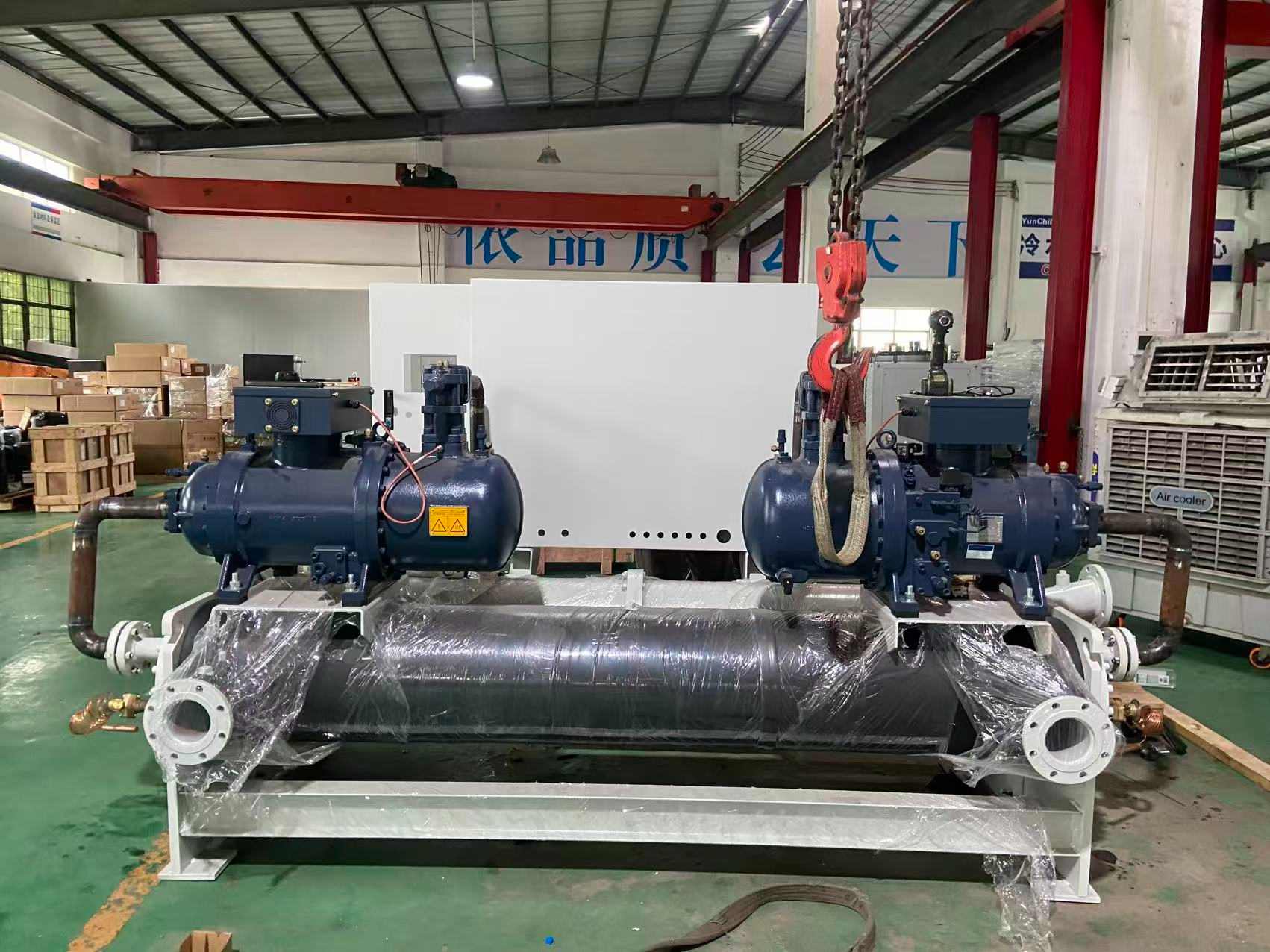
Water-cooled screw chillers utilize twin-screw compression technology.The compressor contains two high-speed rotating screw rotors: a male rotor and a female rotor.As refrigerant enters, the rotation of the screws generates continuous compression.Compared to scroll compressors, screw compressors offer greater individual unit capacity, longer operational lifespans, and superior load regulation capabilities, making them ideal for continuous production environments. Consequently, they are widely used in the chemical industry, pharmaceutical plants, large-scale injection molding facilities, data centers, and central air conditioning systems. Screw chillers often hold a distinct advantage in industrial settings requiring 24/7, year-round operation.
II. Functional Differences
Although both utilize water circulation for cooling, their functional roles differ. Both types of equipment employ water-cooled heat exchange for refrigeration; the core differences lie in compressor configuration, applicable cooling capacity, temperature control precision, operational suitability, and load regulation performance. The specific differences are as follows:
1. Compressor Configuration: Water-cooled scroll chillers utilize multiple small compressors, whereas water-cooled screw chillers typically feature a single large compressor.
2. Applicable Cooling Range: Scroll chillers are suited for small-to-medium cooling requirements, while screw chillers are better adapted to medium-to-large-scale cooling applications.
3. Temperature Control Performance: Scroll chillers offer higher temperature control precision, whereas screw chillers provide greater stability in temperature control during operation.
4. Operational Suitability: Scroll chillers are better suited for intermittent operation, while screw chillers are capable of meeting the demands of long-term, continuous operation.
5. Load Regulation Capability: Scroll chillers regulate load via staged control, whereas screw chillers feature excellent stepless load regulation capabilities.
The primary advantage of scroll chillers is flexibility; for instance, when the load decreases, specific compressors can be shut down to reduce energy consumption.In contrast, screw chillers typically achieve more precise capacity adjustment through slide valve regulation or variable frequency control, ensuring greater operational stability in large-scale systems.
III. Performance Differences: Which is More Energy-Efficient?
Many users assume that "larger machines are inherently more energy-efficient," but in reality, a chiller's energy efficiency depends on the operating environment.
1.Low-Load Operation: Scroll Chillers Have the Advantage
Ideal for scenarios with short daily operating times and significant fluctuations in cooling load—such as high cooling demand in the morning, reduced production in the afternoon, and shutdown at night. Scroll chillers can adjust output by adding or removing active compressors. Advantages: Avoids frequent high-power operation, offers high partial-load efficiency, and entails lower initial investment costs.
2. Long-Term Full-Load Operation: Screw Chillers Offer Higher Efficiency
For large factories operating 16–24 hours a day with stable cooling demands exceeding 100 kW, screw chillers typically perform better. Reasons: Screw compressors offer high compression efficiency and large per-unit capacity, ensuring greater stability during prolonged operation. Additionally, water-cooled systems maintain more stable condensing temperatures than air-cooled systems, allowing large water-cooled screw units to achieve superior overall energy efficiency.
IV. Maintenance and Repair Differences
When selecting a chiller, one must consider long-term maintenance costs alongside the purchase price. Maintenance Characteristics of Water-Cooled Scroll Chillers.Advantages: Simple structure, lower technical requirements for repair, and lower spare parts costs.
Routine maintenance primarily includes:
1. Cleaning the condenser: Scale buildup reduces heat exchange efficiency.Recommendation: Inspect every six months; shorten this interval in areas with poor water quality.
2. Checking refrigerant pressure: Prevents insufficient cooling and compressor overheating.
3.Checking the electrical system:
Includes contactors, control boards, and protection devices. If a scroll compressor fails, the standard repair method is to replace the entire unit. Maintenance Characteristics of Water-Cooled Screw Chillers. Screw chillers have more demanding maintenance requirements. Key focus areas include:
1. Lubricating oil management
Screw compressors rely on lubricating oil to seal rotor clearances, reduce friction, and assist with cooling. Therefore, regular checks are required for: oil levels, oil filters, and oil quality.
2. Inspection of screw rotor condition
After prolonged operation, checks are needed for: rotor wear, bearing condition, and compression efficiency.
3. Control system maintenance
Large screw chillers are typically equipped with PLC controls, pressure sensors, and variable frequency drive (VFD) systems, requiring a higher level of maintenance expertise.
However, a well-maintained screw chiller can operate for a longer period.
V. Differences in service life
Chiller lifespan is influenced by factors such as the operating environment, runtime, water quality, and maintenance frequency. Generally speaking: water-cooled scroll chillers last 8–12 years, while water-cooled screw chillers last 12–20 years.
Scroll chillers Advantages: Low initial investment, easy replacement.
Disadvantages: Individual compressor lifespan is affected by operating frequency; long-term operation under heavy loads places significant stress on the unit.
Screw chillers Advantages: Industrial-grade design, strong continuous operation capability, and higher component serviceability.
With annual maintenance performed according to specifications—such as changing lubricating oil, cleaning heat exchangers, and inspecting control systems—a service life of over 15 years is not uncommon.
VI. How to choose between water-cooled scroll chillers and water-cooled screw chillers?
The choice shouldn't simply be based on price; it should be determined by actual operating conditions.
Suitable for water-cooled scroll chillers:
Lower cooling capacity requirements
Limited daily operating hours
Strict noise requirements
Limited budget
Need for modular scalability
Examples: Small processing plants, laboratories, medical equipment.
Suitable for water-cooled screw chillers:
Large-scale industrial production
24-hour continuous operation
Stable cooling demand
Focus on long-term energy savings
High reliability requirements
Examples: Chemical production lines, large injection molding enterprises, central air conditioning systems.
Summary: Water-cooled scroll chillers vs. water-cooled screw chillers
Simply put:
Water-cooled scroll chillers are like "compact, flexible cooling units"; their advantages lie in their simple structure, ease of maintenance, and low investment cost. Water-cooled screw chillers are akin to "industrial-grade equipment designed for long-term operation," offering advantages such as high cooling capacity, superior efficiency, and a long service life.
For enterprises prioritizing initial investment costs and requiring low-to-medium cooling capacities, scroll chillers are a sensible choice; however, if the requirement involves years of continuous operation and a desire to minimize long-term energy costs, screw chillers generally offer greater advantages.
When making a purchasing decision, one should evaluate factors such as cooling capacity requirements (kW), operating hours, load fluctuations, water quality, and maintenance capabilities, rather than simply comparing equipment prices.

 Get a Quote