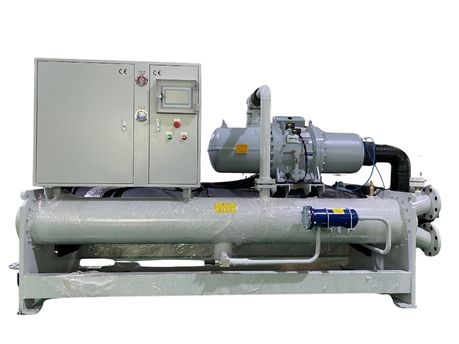
In modern industrial safety and large-scale building central air conditioning systems, efficient and stable refrigeration equipment is the cornerstone of production safety and environmental comfort. Among them, screw chillers, with their compact structure, stable operation, and high energy efficiency ratio, have become the absolute mainstay in medium-to-large-scale refrigeration demand areas. This type of equipment relies on the stepless combination of a male and female twin-screw compressor to compress the refrigerant, thereby achieving a continuous and highly efficient refrigeration cycle. Due to its fewer shutdown components and low failure rate, it effectively avoids the compressor shutdown of traditional reciprocating compressors, demonstrating significant advantages in long continuous operation scenarios.
The cooling methods and structural forms of the equipment also vary depending on different usage environments and resource conditions. For example, in areas with scarce water resources or where cooling tower installation is not feasible, air-cooled screw chillers offer extremely high practical value. By highly integrating an air-cooled finned heat exchanger with the screw compressor, the condensation heat is directly carried away by strong airflow, eliminating the need for complex cooling water systems and spray configurations, and greatly simplifying on-site installation and daily maintenance processes. This flexible design has led to its widespread application in commercial plazas, data centers, and small and medium-sized factories.
However, in specialized processes requiring extremely low operating temperatures, such as fine chemicals, pharmaceutical synthesis, and food quick-freezing, constant-temperature refrigeration equipment often falls short of performance standards. In these cases, cryogenic refrigeration units play an irreplaceable role. These units, employing specially optimized refrigerant ratios, special frozen materials, and multi-stage subcooling or stacked refrigeration technologies, can maintain operation at temperatures as low as -10°C or even at metered outlet water temperatures. Understanding the operating mechanisms and applicable boundaries of these different types of equipment is crucial for companies to rationally plan refrigeration solutions and achieve cost reduction and efficiency improvement.

 Get a Quote