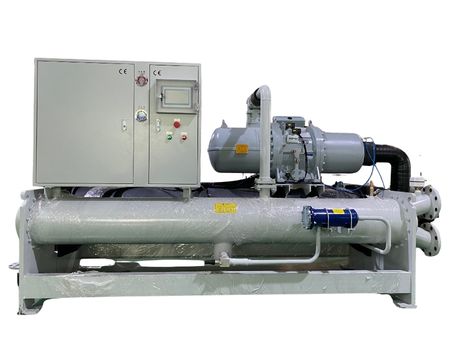
Temperature control is one of the key parameters affecting the yield rate of industrial products and the speed of chemical reactions. With the increasing demands for precise temperature control in production processes, screw chillers, as the core of cooling systems, bear the heavy responsibility of providing a stable cold source for various production lines. From a basic structural perspective, the progressive compression of the refrigerant through twin screws achieves high-pressure circulation. Equipped with an intelligent microcomputer control system, it can automatically adjust the cooling capacity according to changes in heat load, ensuring that the chilled water outlet temperature is precisely constant within the set range.
Under extreme process conditions, general-purpose equipment needs to be adapted to specialized applications. For example, in biopharmaceutical preparation and low-temperature crystallization purification processes, the process flow often requires the refrigerant to reach extremely low temperatures below zero degrees Celsius. Low-temperature screw chillers are designed specifically for such extreme conditions. Their systems, enhanced with improved sealing and upgraded with low-temperature resistant materials, can maintain a high compression ratio at low evaporation temperatures. This not only effectively prevents the risks of oil circuit freezing and compressor liquid return but also ensures continuous low-temperature cooling in ultra-low temperature environments.
Beyond the extended temperature dimension, site limitations and environmental pre-set conditions are also crucial factors in equipment selection. In situations where water quality is scarce, water resources are limited, or water circulation conditions cannot be met, air-cooled screw chillers, with their "plug-and-play" heat dissipation advantage, directly discharge water into the atmosphere, alleviating reliance on water-cooling systems and significantly reducing maintenance costs for antifreeze and water treatment. Through this reasonable matching with near-refrigeration equipment, industrial enterprises can establish temperature control solutions that combine economy and reliability.

 Get a Quote