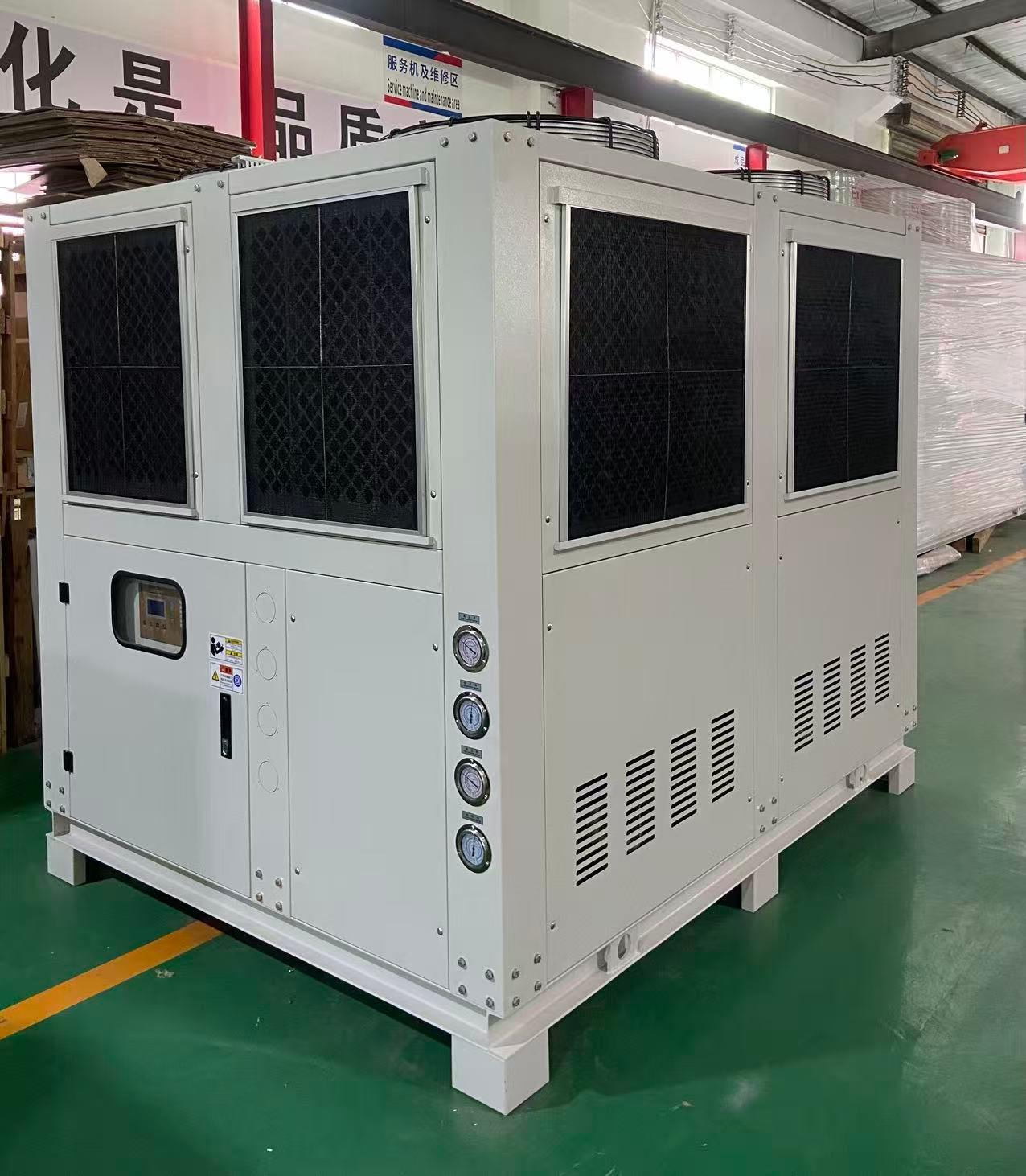
Air-cooled chillers are common industrial refrigeration equipment that provide continuous cooling for industrial machinery and production materials. Different from water-cooled chillers, they need no cooling towers or external water sources and release heat through built-in fans. Featuring simple and flexible installation and operation, they are ideal for small and medium-sized factories and outdoor working environments.
1. Automatic Working Principle
It adopts an automatic closed-loop heat transfer cycle with no manual operation required. Firstly, the evaporator absorbs heat from process water to produce chilled water for production cooling. Secondly, the compressor turns the heat-absorbed refrigerant into high-temperature and high-pressure gas. Then the fan and condenser dissipate heat into the air to liquefy the refrigerant. Finally, the refrigerant decompresses and cools down, and re-enters the cycle to ensure stable and continuous chilled water supply and temperature control.
2. Core Advantages Over Water-cooled Chillers
It cancels supporting facilities such as cooling towers and water pipelines, saving factory floor space. It also avoids regular water quality treatment, greatly reducing the procurement and maintenance costs of water circuit infrastructure. It perfectly solves the installation limitations of traditional refrigeration equipment, especially for space-constrained factories and sites with inconvenient water pipe layout.
3. Maintenance & Applicable Industries
The equipment has fewer components and no complex water pump and cooling tower accessories, leading to simple daily maintenance, low failure rate and less labor cost. Its streamlined installation also lowers overall project costs. It is widely used for temperature control in machining, light industry, small chemical processing, food processing and other industrial. scenarios.

 Get a Quote